
Only about 3% of B2B visitors fill out a form. How to see which companies visit your site each week, match them to your CRM and reach them by hand.
By Lester Laine · October 2026
Most B2B teams treat their website like a brochure with a form at the bottom. If someone fills in the form, sales gets a lead. If not, the visit becomes a line in an analytics report nobody opens.
That rule made sense when the form was where the conversation started. It isn't anymore. 6sense's 2025 Buyer Experience Study found that buyers are 61% of the way through their journey when they first contact a seller, that 79% of them initiate that contact themselves, and that 94% have already ranked their shortlist before talking to any vendor. The vendor ranked first wins 77% of the time.
The decision forms in the stretch you don't see. A good part of that stretch happens on your own website.
In the last article I wrote about old signals, the ones most teams throw away after 90 days. This one is about the fresh ones, arriving every week, that most teams never look at.
The 97% you never meet
Only about 3% of B2B website visitors fill out a form, according to 6sense research reported by Demand Gen Report. Buying teams average around ten people, so even when a form arrives, it usually represents one or two members of a group that has been reading your pages for weeks.
The other 97% aren't noise. They include the CFO who checked your pricing page twice, the operations lead who read three case studies, the IT manager who looked at your integrations page the week their current contract came up for renewal. They didn't introduce themselves. That doesn't mean they weren't there.
What you can actually see
You can't know every person. You can know far more than most teams do, from two sources.
The company behind the visit. Reverse-IP tools match a visit to the company network it came from. Vendors put typical company-level match rates at roughly 40 to 65% of B2B traffic in the US and somewhat lower in Europe, with person-level matching much lower. Treat those as vendor ranges, not promises. Remote workers on home broadband and mobile traffic match poorly, so your real number depends on who your buyers are and where they work.
The people you already know there. This is the source almost everyone ignores: your own CRM. When an identified company visits, the useful question isn't only "who is this company?" It's "who from this company do we already know?" A past webinar attendee, an old inbound lead, a contact from a deal lost two years ago, a former customer's champion who moved there. That match turns an anonymous visit into a name, a history and a reason to talk.
Most teams have the first source sitting unused in a tool they already pay for. Almost none connect it to the second.
A weekly ritual, not a dashboard
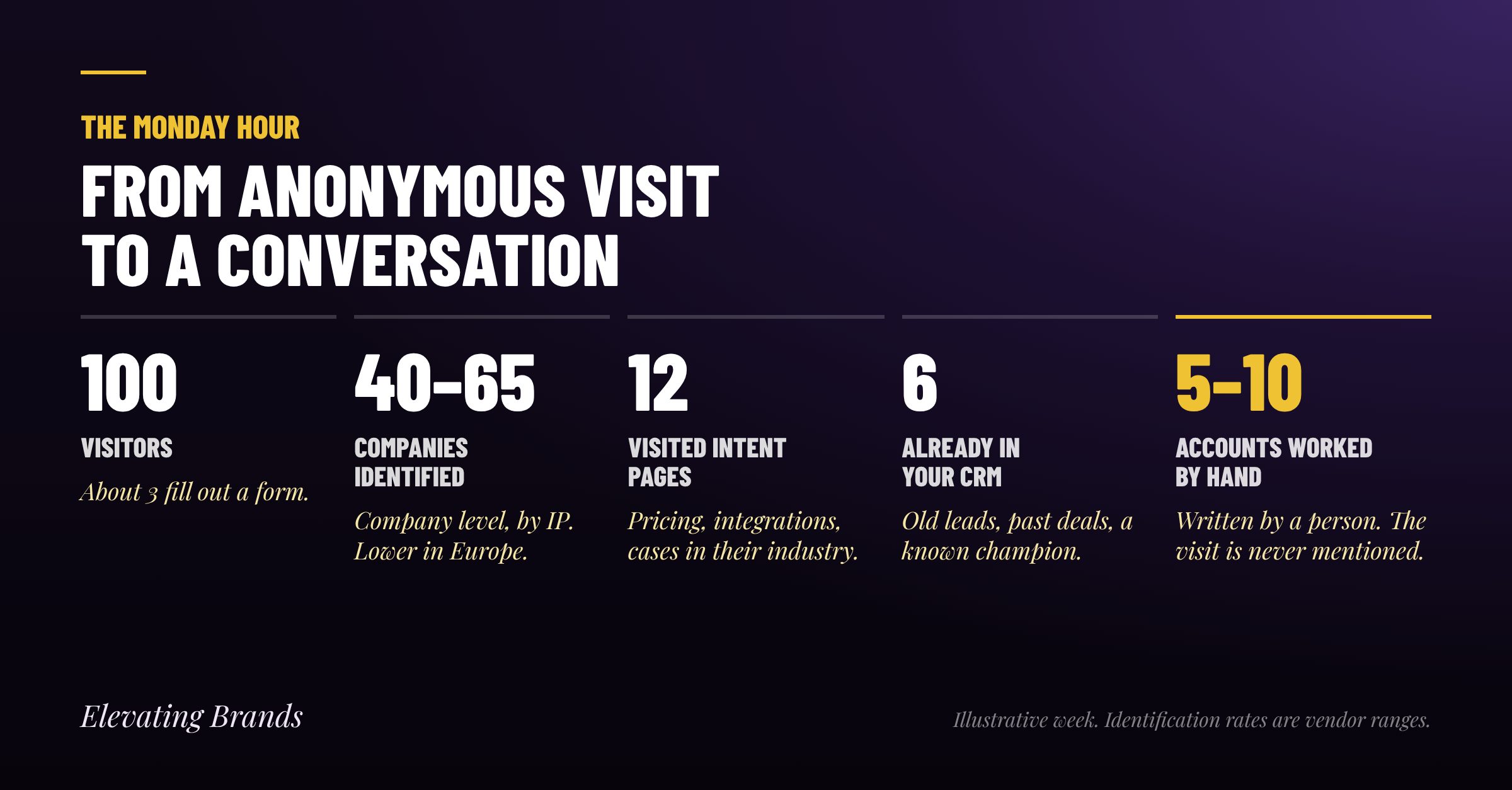
Visitor tools usually fail for a simple reason: they produce a dashboard, and nobody owns it. What works is a short routine with an owner and a day. I run it on Mondays and it takes about an hour.
- Pull last week's identified companies. Remove competitors, internet providers, universities, job seekers and customers in a steady state.
- Score by pages, not by visits. Pricing, integrations, security, implementation and case studies in their industry count. The careers page and the blog home don't. A return visit after weeks of silence counts more than ten visits in one afternoon.
- Match against the CRM. Known contacts, open and past opportunities, closed-lost reasons, old form fills, support history.
- Pick five to ten accounts. Not fifty. The point is depth, and depth doesn't scale past what one person can write well in a week.
- Decide a play per account. Who on your side, which person on theirs, and what they need at the phase they're probably in: a peer case, an evaluation checklist, an introduction through someone they trust.
- Write by hand and log the outcome on the account timeline, as a dated event. Next Monday starts from what happened this week.
The rule that keeps this from being creepy
Never write "I saw you were on our pricing page." It's a surveillance message, and it burns the trust you're trying to build.
The visit tells you when to reach out and what to talk about. It never goes in the message. A good message reads as if you happened to be relevant: a case in their industry, a question about the problem they're probably evaluating, a note from someone they already know.
This is also why I keep AI on the signal side only. Software is very good at noticing that a company came back three times in ten days and read the same two pages. It's bad at writing to a CFO who is comparing five vendors. Detection can be automated. The conversation should be written by a person who has looked at the account.
Why small teams have the advantage here
Enterprise teams buy 6sense or Demandbase and route thousands of accounts into automated plays. A 30-person B2B company can't, and doesn't need to.
If 40 companies are identified on your site in a week and eight of them looked at pages that matter, the founder or head of sales can personally write to all eight. No enterprise team does that. Their volume won't let them. Your size is the reason you can.
The tooling isn't the expensive part. Company-level identification is affordable, and many CRMs and analytics tools already include some version of it. The expensive part is the hour on Monday, and the discipline to protect it.
In SCALING™ terms, this is Instrumentation feeding ABM: signals captured and stored as events, turned into a short list of accounts worked by hand. Neither works alone. Instrumentation without a ritual is a dashboard. ABM without signals is guessing.
Want the playbook?
The Monday Hour Playbook includes the page-scoring sheet, the CRM matching checklist, the account play template and five openers that never mention the visit.
Send me a message on LinkedIn with the word MONDAY and it arrives right away.
Sources
- 2025 B2B Buyer Experience Study, 6sense, November 2025 (via CustomerThink research round-up)
- It's time to target the 97%: 6sense research reveals only 3% of site visitors fill out forms, Demand Gen Report, 2022
- Website visitor identification match rates: what to expect, Abmatic AI (vendor ranges)